Bringing Maritime Heritage to You
The Maritime Museum of BC produces exhibits that are available for travel and can be hosted in other organizations. We aim to make these exhibits accessible for small organizations to host and easy to travel.
Topics and descriptions of exhibits that are available to travel are listed below. We are working on establishing one-page brochures for each exhibit that includes more details including sq/ft required and types of objects that are available to loan to supplement the panels. We will add these brochures to this web page as they become available.
To inquire about an exhibit, please contact us at info@mmbc.bc.ca.
Interested in an exhibit topic not listed here? Let us know! We’re happy to explore new exhibit topics and work with you on a custom exhibit for your space.
Available Exhibits
Please note: This is a new program, and additional details about our available exhibits will be shared soon. In the meantime, if you would like to learn more about any of the exhibits listed below, please reach out to us at info@mmbc.bc.ca.
Few skills are more important at sea than the ability to repair. Sailors need to be self sufficient when out at sea whether they are repairing sails, clothes, nets, anything.
Something as small as a needle and some waxed thread could make all the difference in the harsh conditions of life on the open water. When the sea was calm a creative sailor could also turn to craft to pass the idle hours. The skills that kept them alive also kept them entertained.
Darn It! Our Maritime Make and Mend Culture brings this rich tradition to life through a look at the creation of lifesaving tools and beautiful artworks on the high seas.
Step into the boots of a recruit and explore the evolution of the Royal Canadian Navy through the uniforms worn by those who served. From the iconic square rig to the high-tech safety gear of today, Getting Tiddley reveals how the navy uniform is a symbol of rank, a tool for survival, and a representation of Canada.
The term “Tiddley” is naval slang for looking smart, neat, and sharp. This exhibition traces that standard of excellence through over eighty years of transformation, highlighting the moments when the Royal Canadian Navy began to forge its own path distinct from British traditions.
British Columbia’s coastline is without a doubt a rugged one. Our rocky cliffs, shallow shorelines, and stormy winter seasons all make for difficult passage. This has resulted in hundreds of shipwrecks along our coast.
Mishaps and Misadventures presents only the weird and wacky, with no human tragedy in any of these stories! Through stunning archival photos we feature six ships, including the famous Princess May, SS Beaver, and DGS Quadra, who each got into big trouble on our coast.
A landscape of forbidding bluffs and nearly impassible brush, punctuated by the ominous sound of crashing waves, hardly seems like the route to salvation for someone escaping a sinking ship. For those unlucky enough to find themselves in just that situation along the unforgiving southwestern edge of Vancouver Island, the rough trail over slick rocks and fallen trees may have been their only chance.
The 75-kilometer stretch of coastline from Bamfield to Port Renfrew has evolved from a narrow telegraph track to one of the most popular hiking destinations in Canada in less than a century.
This exhibit follows this rain-soaked path from the tragic wreck of the S.S. Valencia that led to its creation to the stories of adventurers who brave the modern-day West Coast Trail. A wealth of community stories from people with special connections to the trail complements the historical story.
To live on the coast is to be influenced by the ocean every day. Many make their living on the water. It is a source of food and a way of transporting people and goods. It drives changes to our weather. So, what happens when climate change starts to affect a body of water as large as the Pacific Ocean?
The many effects of climate change are rippling through the entire ecosystem. But while we don’t always see it, the ocean plays a key role in carbon sequestration and could be our greatest ally in the fight against climate change. Efforts have already started to boost the power of the Pacific.
An exhibit for ocean lovers, Pacific in Peril explores what climate change could mean for the Pacific and what we can do to help protect it now and for future generations.
The Sinking of the SS Princess Sophia is the worst maritime disaster in the history of the Pacific Northwest. All 343 passengers and crew onboard were killed when the ship sank in Lynn Canal, Alaska, after striking a reef in a snowstorm.
The story is almost a forgotten one. The ship sank just weeks before the end of the First World War. The world was swept up with excitement at the end of the bloody war and did not wish to dwell on more tragedy.
The story has also nearly forgotten because of the grim fact that there were no survivors. No firsthand accounts, no one to testify at the public enquiry, and no one to participate in the class action lawsuit that lasted for years after the event.
In a comprehensive and gripping look at the disaster, this exhibit covers the Sophia’s early days, her long 40-hour ordeal on the reef, attempted rescues, and the fallout after the deadliest wreck in the region’s history.
The mystery and romance of lighthouses have captivated people for generations. We are endlessly attracted to and fascinated by their beautiful architecture, their isolation, and the horrors of their extreme environments. Because of their extreme circumstances, every lighthouse carries unique stories from years past that continue to intrigue.
The BC coast has been home to 59 lighthouses in total, most of which still exist, and all of which carry their own history and purpose. Despite their unique qualities, the lighthouses in BC share common history and trends that have shaped the stations on which they stand, and have which undoubtedly saved many human lives.
This exhibit explores the history of lighthouses in BC and how their use has evolved from 1860 – present.
Through rich, moving, and often witty community contributions from queer folks, Queer at Sea looks at the lives of 2SLGBTQ+ people on the coast. Stories cover the navy, fishing, lighthouses, boat building, ferries, coast guard, and other maritime trades, professions, and hobbies.
Maritime industries have not always been welcoming to those who identify as part of the queer and trans communities. At best, differences in orientation were tolerated as an open secret. More often than not there was blatant hostility and bigotry. At the same time, the sea is a place where others have found love, friendship, and a place to call home. For every story of discrimination, there is one of hope.
There is no single answer of what it means to be queer at sea. Like each person, each story is unique. The more we all listen; the more progress can be made towards a future where no one feels like they have to hide their authentic self.
A flash of silver. A tug on the line.
Whether it was to feed a family or for the pride that came with catching the biggest fish of the season, salmon looms large in the cultural consciousness of BC. These iconic fish have nourished us, driven innovation, and been a way of life for so many.
Salmon Tales takes a dive into the history of how the people of BC have fished from traps to nets to lures. It features stories of those who changed the way we fish as well as those who have dedicated their lives to the thrill of the catch.
This exhibit explores how our relationship with salmon has evolved and what we can do to protect salmon into the future.
The shipwreck of the SS Valencia is well known as one of the worst maritime disasters in an area known as “The Graveyard of the Pacific”. Its tale lives on in BC through ghost stories and it has captured the attention of an international audience.
But what actually happened during this dramatic sinking? How did this “theatre of horror” drag on for 40 hours? What are the human stories behind the infamous scene of the shipwreck?
This exhibit tells the story of the SS Valencia and considers what conditions led to such a horrific ending. By meeting a cast of characters thrown together by fate, visitors will hear the human stories behind the tragedy and consider what effect trauma had on the events.
Valencia’s story is enrapturing and will continue to live on in the lore of BC’s maritime history.
The Great Pacific Garbage Patch is the largest accumulation of ocean plastic and human-made debris in the world. It covers a surface area twice the size of Texas and contains up to an estimated 3.6 trillion pieces. But did you know it’s not actually a “patch”? Or how about the fact that garbage is accumulating in five distinct areas of our oceans? And did you know that your laundry is likely contributing to the problem?
This exhibit invites visitors to learn more about marine debris and plastic in our oceans, including why it exists and how it continues to grow. They will also learn about the efforts from people around the world who are working to better the situation, and even how you can make small changes in your daily life that can contribute to big changes for our oceans.
The west coast of Vancouver Island is a remarkable place – a place deeply connected to life on the water.
Until recently, the only way to access many of the communities along the Alberni Inlet was by sea. The vessels that carried goods, people, and mail up the Alberni Inlet were considered a lifeline for those living in the isolated communities along the way. While many vessels operated in the area, some names stand out in the memories of the inhabitants of the west coast. Visitors will learn about the careers of 20th century vessels like the Princess Maquinna, Uchuck, and the Frances Barkley which carries on the tradition today.
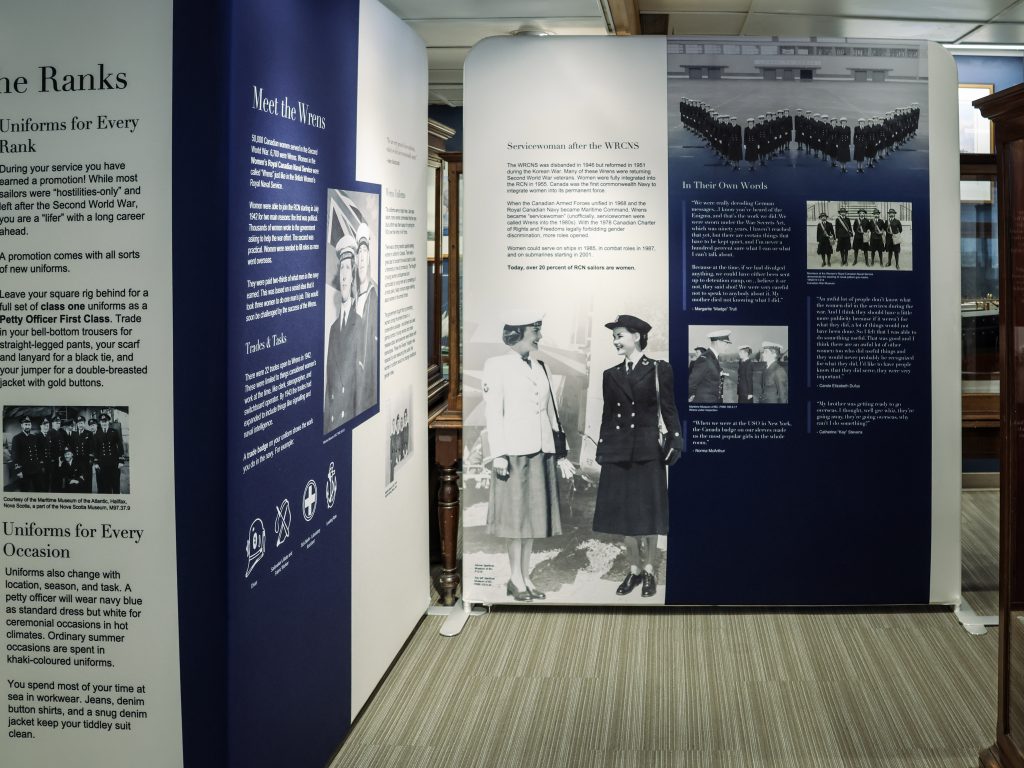
Exhibit Panel Features
All panels are free-standing, modular, and dual-sided.
They each include the following:
- Vivid colour using premium dye-sublimated fabric.
- A pillowcase design that slides over the frame and zips at the bottom.
- Lightweight aluminum frames (with easy, tool free set up)
- A compact fabric carry bag for travel and storage.
Exhibit Loan Fees
Please contact us at info@mmbc.bc.ca and we can provide you with a custom quote based on your needs and budget.
Loan and travel fees can be covered through the MAP Exhibit Circulation Fund. We see ourselves as partners with you and are happy to assist you with this application, if desired.